
A complete blood count (CBC) is one of the most often requested laboratory tests in the medical industry. By offering information on red blood cells, white blood cells, hemoglobin, hematocrit, and platelets, it assists medical practitioners in evaluating a range of clinical scenarios. However, selecting the appropriate *ICD 10 code for CBC* requires more than merely determining the test outcome.
The documented rationale for ordering the test or the condition being assessed should typically be reflected in the diagnostic code given with a CBC claim. The CDC stresses examining the entire medical record to ascertain the precise cause of the contact, and ICD-10-CM is a standardized approach for classifying illnesses and medical problems. Moreover, ICD 10 code for CBC and CMP also play a vital role.
For more accurate reimbursement and cleaner claims, medical practices, labs, and billing teams must comprehend the connection between the laboratory service and the supporting diagnosis.
What Does an ICD 10 Code for CBC Actually Represent?
The CBC laboratory method itself is not represented by the *ICD 10 code for CBC*. Rather, the diagnostic code provides an explanation for the test’s sequence. Symptoms, a known ailment, follow-up therapy, or a preventative screening visit can all lead to a CBC.
This distinction is crucial because laboratory tests are recorded using CPT or other relevant procedure coding systems, but ICD-10-CM codes categorize diagnoses, illnesses, symptoms, and reasons for healthcare interactions. Thus, the documented clinical conditions of the patient provide the diagnosis that underpins the laboratory service.
Why the Reason for Testing Matters?
There are several clinical reasons to obtain a complete blood count (CBC). When assessing tiredness, suspected anaemia, symptoms connected to an infection, irregular bleeding, or any other documented disease, for instance, a clinician could ask for one.
Instead of being picked just because a CBC was done, the diagnosis should match the medical record. Precise documentation lowers the possibility of submitting an unsupported code and assists coders in selecting the diagnosis that best supports the service.
CBC Coding Is Different From Procedure Coding
Confusion between the diagnostic code and the laboratory procedure code is a frequent billing error. Within a claim, they have distinct functions.
For instance:
- * ICD-10-CM* describes the diagnosis or cause of the interaction.
- *CPT* indicates the process or service carried out.
- Documentation links the service to the clinical justification.
- Medical necessity standards may be impacted by payer regulations.
Workflows for laboratory billing may be made more precise and manageable by being aware of these differences.
Understanding the CBC With Differential ICD 10 Code
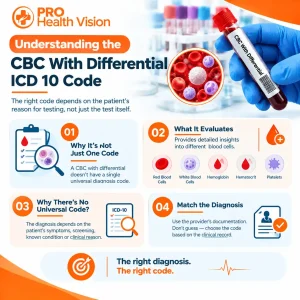
Because there isn’t always a single universal diagnostic code issued only because a CBC has a differential, the term *cbc with differential icd 10 code* may be deceptive. The patient’s recorded reason for testing determines the proper ICD-10-CM diagnosis.
Additional details on the various kinds of white blood cells are provided by a CBC with differential. It might be prescribed in order to assess symptoms, keep an eye on a known problem, or look into a possible illness. Therefore, the patient’s documented clinical state should serve as the basis for the supporting diagnosis.
What a CBC With Differential Evaluates?
A differential gives more details regarding the kinds of white blood cells, whereas a regular CBC examines a number of crucial blood components.
The report may include details on the following, depending on the laboratory test that was ordered:
- Red blood cells/ White blood cells
- Hemoglobin
- Hematocrit
- Platelets
- Various populations of white blood cells
The test conducted and the relevant procedure code should be used to confirm the precise laboratory components.
Why There Is No Single Universal Diagnosis Code?
It is possible to assume that each CBC with differential should have a single diagnostic code while searching for a *cbc with differential icd 10 code*. That method may lead to an incorrect code.
Instead, the disease, symptom, screening encounter, or other recorded cause supporting the laboratory service should be included in the diagnosis. According to the CDC’s coding guidelines, the complete record must be examined in order to identify the precise cause of the interaction.
Match the Diagnosis to the Clinical Documentation
A diagnosis should not be chosen by coders only because it frequently occurs with CBC claims. A diagnosis needs to be backed up by the provider’s records.
The diagnosis-code selection should be guided by the clinical information if the CBC is performed due to a known ailment or recorded symptom. Instead of speculating on the diagnosis, the proper procedure could need the provider to give clarity when the paperwork is ambiguous.
Read More: 78452 CPT Code Description, Documentation, and Modifier Use.
Common ICD 10 Codes for CBC With Differential Scenarios
The clinical indication recorded by the provider determines the *icd 10 codes for cbc with differential*. No single diagnostic code applies to all CBCs with differentials.
For instance, a doctor could request a complete blood count (CBC) if a patient has a known illness, a recorded symptom, or an unusual lab result. The stated diagnosis should be in line with the relevant coding guidelines and the observed situation.
Symptoms May Support Laboratory Testing
While a doctor assesses symptoms including weakness, exhaustion, fever, bruises, or other complaints, a complete blood count (CBC) may be requested. The reported symptom may be important for diagnostic coding when the underlying illness has not been determined.
Coders should, however, adhere to the payer requirements and formal ICD-10-CM criteria that apply to the encounter. Prior to the provider establishing or documenting the diagnosis, a test result should not be regarded as a verified diagnosis.
Established Conditions May Explain the CBC
In order to track or assess an existing condition, a CBC may also be requested. Blood testing, for instance, might be used by a healthcare professional to keep an eye on a documented hematologic problem or another ailment that affects blood levels.
In these situations, the medical record should support the pertinent diagnosis. Compared to using a generic screening code, using the appropriate condition-specific code can offer a more lucid justification for medical need.
Abnormal Findings Can Affect Coding
A laboratory test may occasionally be requested due to an aberrant result from earlier testing. According to ICD-10-CM rules, an appropriate abnormal-finding code may be taken into consideration if the physician cites the abnormal finding as the cause for additional examination.
For this reason, it is never appropriate to choose the *icd 10 codes for cbc with differential* only from the laboratory order. The clinical documentation and the reason the test was requested by the physician must be taken into account for coding.
ICD 10 for CBC Screening: What Should You Know?
Whether or not the CBC is actually being conducted as a screening service determines the *icd 10 for CBC screening*. Screening is defined by ICD-10-CM as testing asymptomatic individuals for disease or disease precursors to enable early detection and treatment.
*Z13.0*, which denotes an encounter for screening for diseases of the blood and blood-forming organs and certain disorders involving the immune mechanism, is one category that may be pertinent.
When Screening and Diagnostic Testing Differ
Diagnostic testing and screening are not the same thing. Testing an asymptomatic individual without a known illness or symptom under investigation is often part of a screening visit.
The visit may be diagnostic rather than screening if a patient has symptoms and the doctor requests a complete blood count to look into those symptoms. ICD-10-CM makes a clear distinction between screening visits and diagnostic tests related to symptoms or indicators.
Review the Documentation Before Using a Screening Code
Billing teams should examine the encounter documentation prior to providing a *icd 10 for CBC screening.
Important queries consist of:
- Does the patient have no symptoms?
- Is the test diagnostic or preventive?
- Did the supplier record a particular explanation?
- Is a predetermined state under observation?
- Does the payer have any particular restrictions regarding coverage?
The improper use of screening diagnostics is avoided thanks to this review.
Screening Does Not Guarantee Coverage
Reimbursement is not always assured, even in cases where a screening diagnostic is justified. The patient’s insurance plan, benefit structure, payer policy, medical necessity regulations, and the particular care rendered can all affect coverage.
Therefore, rather than presuming that a certain screening diagnostic ensures payment, billing teams should confirm applicable payer criteria.

ICD-10 Code for CBC and CMP
| Clinical Reason for CBC and CMP | ICD-10-CM Coding Approach | When It May Apply |
| Screening | Use an appropriate screening code, such as Z13.0 when the encounter meets the criteria for screening for diseases of the blood and blood-forming organs and certain immune disorders. | Asymptomatic patient undergoing qualifying screening |
| Symptoms | Code the documented symptom or complaint that prompted the laboratory testing. | Fatigue, weakness, fever, bruising, or other documented symptoms |
| Established Condition | Report the documented condition being monitored or evaluated. | An existing hematologic or other condition requiring laboratory monitoring |
| Abnormal Previous Results | An appropriate abnormal-finding code may be considered when the provider documents the abnormal result as the reason for additional testing. | Follow-up of a previously abnormal laboratory finding |
| Preventive/Diagnostic Evaluation | Select the diagnosis that accurately reflects the documented purpose of the encounter. | When the provider documents a specific preventive or diagnostic reason |
Conclusion
It’s not just about memorising one ICD 10 code for CBC, it’s about reading the chart and picking the diagnosis that best reflects what the provider actually documented, whether it be a symptom, a condition that is already present, a screening visit, or a follow-up on an aberrant result. Skipping that step is one of the quickest ways a clean claim might become a denial, for example.
This is the kind of thing our coding and billing staff at Pro Health Vision takes care of on a daily basis, so you don’t have to question every CBC claim before it gets out. If your revenue cycle is being bogged down by claim denials or code ambiguity, contact us and we’ll fix it together.
FAQ
Does CBC have a single ICD 10 code?
No single ICD-10-CM diagnostic code applies to all CBCs. The reason for the test’s order and the information in the medical record will determine the proper diagnosis. Depending on the situation, a CBC conducted for screening, symptoms, an existing ailment, or an abnormal result may call for a different diagnosis-code decision.
What is the CBC with differential ICD 10 code?
The fact that a differential was carried out does not inherently indicate a *cbc with differential icd 10 code*. The laboratory technique itself is not represented by ICD-10-CM codes, but rather diagnoses or grounds for encounters. The provider’s documentation and the relevant coding requirements for the particular encounter should be taken into consideration when choosing the appropriate diagnosis.
What is the ICD 10 for CBC screening?
When the encounter satisfies the criteria for screening for blood and blood-forming organ illnesses as well as certain immunological disorders, the *icd 10 for CBC screening* may entail Z13.0. Before filing the claim, coders should verify that the patient and interaction truly fulfil screening criteria and examine any applicable payer restrictions.
Can the lab result itself be used to pick the diagnosis code?
No An abnormal CBC test is not a diagnosis in and of itself. The ICD-10-CM code must to represent what the physician documented as the purpose for the test, not what the lab occurred to find. If a result is abnormal, that can only support a code if the supplier documents it as the basis for future testing.
Is the coding process different for a CBC versus a CBC with differential?
Not in ICD-10-CM terms. If the CBC was ordered as a routine CBC or as a CBC with differential, the diagnosis code is still based on the documented cause for the encounter—a symptom, a known condition, a screening visit, or an aberrant finding. The differential is a lab detail (attached to the CPT code), not something that influences diagnostic selection.
Who is responsible for selecting the correct diagnosis code — the lab, the biller, or the provider?
The diagnosis code is eventually supported by the provider documentation. Coders and billing teams are the ones that take that documentation and turn it into the accurate ICD-10-CM code, but they shouldn’t have to guess or fill in the blanks if the notes are ambiguous. If the rationale for testing is not properly stated, the appropriate step is to ask the supplier for clarification rather than assigning a code based on assumption.