Accurate coding ensures medical practices receive proper payment for diagnostic work. Pathology services rely on specific CPT codes to report tissue studies done in labs. Understanding the rules for cpt code 88305 helps practices submit clean claims and prevent severe billing delays.
Proper coding directly protects practice revenue while keeping your facility compliant with insurance guidelines. Billing teams must understand the exact definition, technical components, and diagnosis rules tied to this service. At Pro Health Vision, we help medical providers navigate these complex coding rules with ease.
CPT Code 88305 Definition
The official cpt code 88305 description covers Level IV surgical pathology tissue examination. This service involves the gross and microscopic evaluation of tissue specimens sent to a lab. The pathologist that looks at the tissue sample is looking for evidence of disease or infection.
This medical code 88305 applies to intermediate-level tissue complexity. Pathologists use it when the examination requires more work than simple skin tags, but less effort than complex organ resections.
Why Is CPT Code 88305 Important in Pathology?
This single code carries more claim volume than any other in the surgical pathology series. This category is the first to which almost every biopsy that arrives on a pathologist’s bench is sorted.
The importance goes beyond volume. Accurate use of this code protects patient care too. A correct level assignment means the lab gets paid fairly for the work involved, and that keeps diagnostic services running without financial strain on the practice.
Auditors also watch this code closely. Because it covers so many specimen types, it draws more scrutiny than lower-volume codes. A pathology group that understands the rules avoids most of that risk before it starts.
Procedure and Example of CPT Code 88305 in Use
The doctor performs a biopsy and then sends the tissue sample to the lab to start the process. Pathologists cut the material, place it on slides and add special stains. The pathologist then views the slide with a high power microscope and renders a final diagnosis.
One of the most prevalent clinical scenarios is when a gastroenterologist is doing an endoscopy. The doctor saw an inflammatory spot and took a little sample of tissue from the stomach. The tissue samples is received by the lab, the sample is processed, and the pathologist confirms gastritis under the microscope. The laboratory will then bill for this service under Level IV surgical pathology.
Read More: 73721 CPT Code | Description, Rates, and Billing Rules
Common Diagnoses Associated with CPT Code 88305
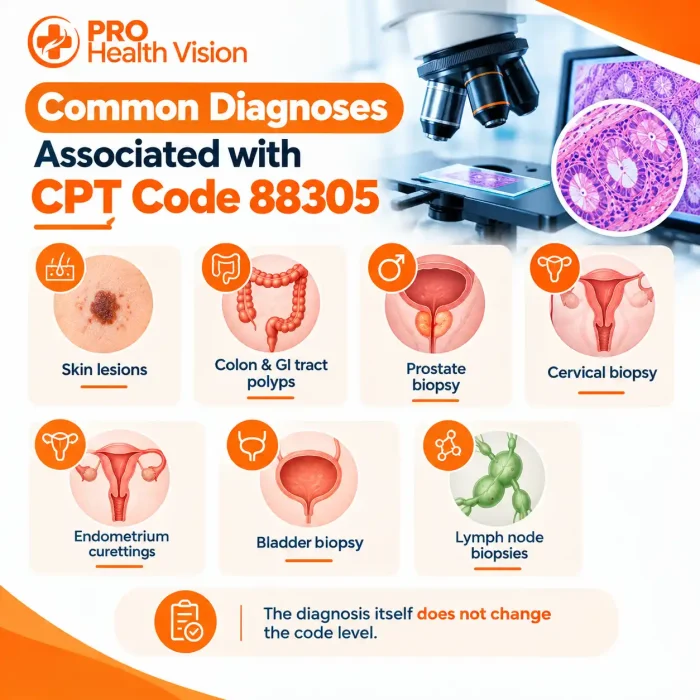
This code shows up across many diagnostic categories because the specimen list is broad. Common examples include:
- Skin lesions including moles and possible skin malignancies.
- Endoscopic detection of polyps of the colon and gastrointestinal tract
- Prostate needle biopsy for prostate cancer screening
- Biopsy of the cervix during gynaecological examinations
- Endometrium curettings for irregular uterine haemorrhage
- Biopsy of the bladder for suspected urothelial diseases
- Lymph node biopsies are performed if a single node is submitted
The diagnosis itself does not alter the code level. If the specimen type is one of the permitted specimen types. Then the Level IV category is the same for a benign skin tag and a malignant melanoma biopsy.
Documentation Requirements for CPT 88305
Clean documentation is what keeps this code out of the denial pile. Payers expect a clear paper trail connecting the order to the final report. At minimum, the record should include:
- A physician’s order requesting the pathology exam
- Patient demographics and specimen source
- The gross description written by the pathologist
- Slide preparation and staining notes
- The microscopic findings
- A final, signed diagnosis
- The pathologist’s authentication on the completed report
Missing any of these pieces provides a reviewer a reason to doubt the claim. Labs that include documentation checklists into their workflow catch flaws before the claim leaves the building, not after a denial is received.
Billing and Coding Best Practices for CPT 88305
Coding teams must handle modifier usage correctly to report the separate parts of this diagnostic service. Modifier 26 reports the professional component performed by the pathologist. Modifier TC reports the technical component covering lab equipment, supplies, and technician labor.
Billing without modifiers means the facility provides both the lab work and professional interpretation under a global service. Always check payer policy rules before applying separate component modifiers.
Reimbursement Guidelines for CPT Code 88305
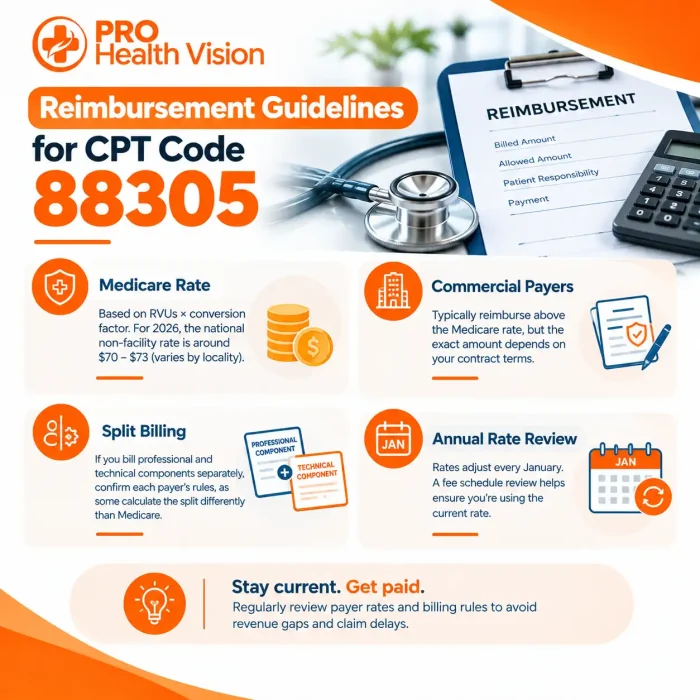
Medicare reimbursement for this code is based on relative value units, or RVUs, multiplied by a yearly conversion factor. For 2026, the national non-facility Medicare rate lands in the neighborhood of $70 to $73, though this varies by geographic locality.
Commercial payers typically reimburse above the Medicare rate, but the exact figure depends on the contract terms a practice has negotiated. Labs that split billing between professional and technical components should confirm each payer’s rules on how that split affects the total reimbursement, since some carriers calculate it differently than Medicare does.
Rates adjust every January, so a fee schedule review at the start of each year is worth the time. A rate that was accurate last year may already be outdated.
Limitations and Exclusions for CPT Code 88305
Not every specimen qualifies for this code. Simple specimens like a skin tag removed for cosmetic reasons, or a fallopian tube segment from a routine sterilization, usually fall into a lower-level code instead.
On the other end, complex resections such as a partial colon removal for cancer, or a full organ resection, belong in a higher-level code because the pathologist’s workup is more extensive.
This code also excludes cytology services, such as Pap smears or fine needle aspiration cytology, which use an entirely different set of codes. Mixing these up is a common source of confusion for newer coding staff.

Common 88305 Denials and How to Prevent Them
A handful of issues account for most denials tied to this code:
Level misassignment. Billing a specimen at the wrong complexity level, often when a simple specimen gets coded here by mistake. Cross-check the specimen against the approved list before submitting.
Missing documentation. A claim without a signed report or a complete gross description gets flagged fast. Build documentation review into the workflow before claims go out.
Incorrect unit counts. Billing one unit for multiple specimens, or the reverse, throws off the entire claim. Confirm the specimen count against the pathology report line by line.
Medicare prostate biopsy errors. Using this code instead of G0416 for a Medicare prostate case triggers an almost automatic rejection.
Modifier stacking mistakes. Appending both TC and 26 on the same line, or omitting a needed modifier when work was split between two entities, causes processing delays.
A practice that reviews claims against this list before submission, or works with a partner like our Virginia Medical Billing Services team, tends to see far fewer denials over time.
Conclusion
CPT code 88305 is the backbone of surgical pathology billing, covering the biopsies that make up most lab volume. Getting the specimen count, documentation, and modifiers right protects your reimbursement and keeps audits at bay. At Pro Health Vision, we help pathology practices apply these rules correctly every day. If your claims are running into denials, our billing team can review your workflow and tighten it up. Contact us today to get started.
FAQs
What does CPT code 88305 cover?
It covers the gross and microscopic examination of a Level IV surgical pathology specimen, such as a skin biopsy or colon biopsy.
Is CPT 88305 billed per specimen or per slide?
Per specimen. Each separately accessioned specimen gets its own unit, regardless of how many slides were made from it.
Can CPT 88305 be used for a Medicare prostate biopsy?
No. Medicare requires HCPCS code G0416 for prostate needle biopsies instead of this code.
What is the 2026 Medicare reimbursement rate for this code?
The national non-facility rate is roughly $70 to $73, though it varies by locality and adjusts each January.
What is the difference between modifier 26 and modifier TC on this code?
Modifier 26 covers the professional interpretation by the pathologist. Modifier TC covers the technical work of preparing and processing the specimen. They should never appear on the same claim line for the same specimen.