
Managing healthcare finances requires clear communication between insurance companies and medical practices. When providers submit claims, understanding payment decisions is vital for stable cash flow.
Many healthcare staff ask what does era mean in medical billing when handling digital payment records. This guide explains how electronic remittances work, how they speed up payments, and how to fix posting issues.
What Does ERA Stand for in Medical Billing?
ERA in medical billing is short for Electronic Remittance Advice. This file is sent from a payer to a provider after they have reviewed a claim. This is in lieu of the printed notice that used to be mailed out.
The file travels in a standard format called the 835 transaction. HIPAA rules require this format for electronic healthcare payments. That standard lets billing software read the file without manual entry.
Understanding what ERA stands for in medical billing helps the rest of this guide make sense. Once a claim gets processed, this file explains exactly what happened to it.
Key Components of an ERA

An ERA file breaks down reimbursement details using standard transaction codes. Every file includes key pieces of data:
- Claim Status: Shows if claim was authorised, refused or pended for information.
- Paid Amounts: Total paid by payer and patient responsibility (copays, deductibles, etc.)
- Adjustment Codes: Uses Claim Adjustment Reason Codes (CARCs) and Remittance Advice Remark Codes (RARCs) to explain changes in payment.
- Provider Details: Includes National Provider Identifier (NPI) numbers and tax identifiers for proper matching.
Understanding these codes helps staff post payments accurately and file appeals quickly.
The Benefits of Using Electronic Remittance Advice in Medical Billing
Shift to era in medical billing streamlines digital payment operations, reduces manual effort.
- Faster Processing: Automated files eliminate manual data entry from paper forms.
- Fewer Human Errors: Digital posting matches payments directly to patient files with high precision.
- Quick Denial Tracking: Staff see denied claims right away, allowing fast claim resubmissions.
- Better Cash Flow: Combining digital remittance with electronic bank deposits reduces payment turnaround times.

The Challenges of ERA in Medical Billing
Digital remittance brings huge benefits, but practices still face daily administrative obstacles.
- Setup Delays: Enrollment with individual payers can take several weeks to complete.
- System Mismatches: Practice management software must parse complex EDI 835 files without glitching.
- Unmatched Payments: A digital remittance file without a matching bank deposit creates accounting gaps.
- Unclear Denial Codes: Decoding complex adjustment codes requires trained billing staff.
Common ERA Errors and How to Address Them
Posting errors can stall practice revenue. Resolving discrepancies keeps accounting records balanced.
| Common ERA Error | Root Cause | Best Action to Fix |
| Unmatched ERA and EFT | Bank deposit arrives on a different day than the file | Set clearinghouse rules to auto-match files within 72 hours |
| Missing Claim Adjustments | Payer uses non-standard remark codes | Cross-reference payer portal guidelines for updated CARC rules |
| Duplicate ERA Posting | File re-sent after network connectivity loss | Enable duplicate detection settings in billing software |
Fixing these errors promptly prevents incorrect balance billing for patients.
ERA vs. EOB: Key Differences
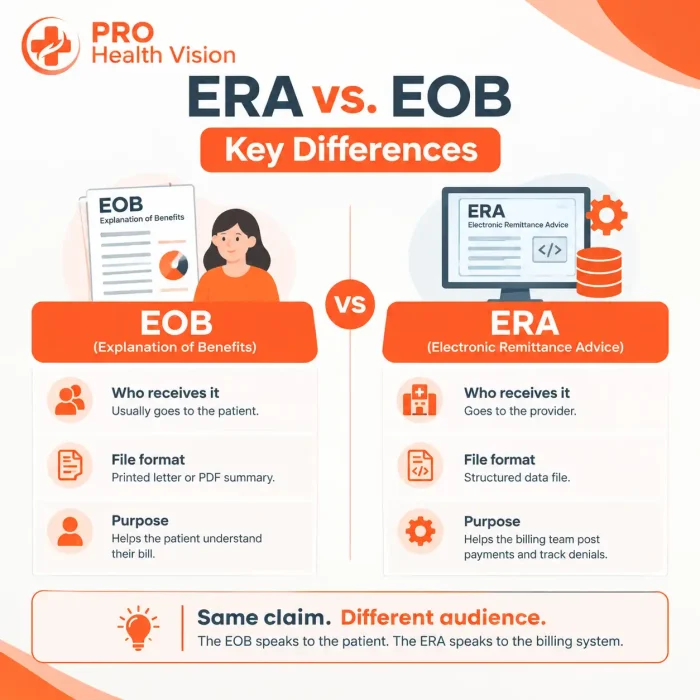
What is EOB and ERA? People often ask how the two documents are different. Both describe how a payer processed a claim, but they are for distinct audiences.
Who receives it
An EOB usually goes to the patient. It shows what the insurance paid and what the patient still owes. An ERA goes to the provider and carries more billing detail for posting payments.
File format
An EOB is often a printed letter or a PDF summary. An ERA is a structured data file, built so billing software can read it automatically.
Purpose
An EOB helps a patient understand their bill. An ERA helps a billing team post payments and track denials without manual entry.
The difference between EOB and ERA comes down to audience and format, not the claim itself. Both documents can describe the same claim from two angles. The EOB speaks to the patient. The ERA speaks to the billing system.
Conclusion
Knowing what does ERA mean in medical billing helps a practice run its billing with fewer delays. The file speeds up payment posting and cuts down on manual errors. Small setup issues and unfamiliar codes are the main hurdles most practices face early on.
Pro Health Vision offers medical billing services in Virginia built around exactly this kind of detail. Book a free billing consultation with the team today and see where a practice can save time and recover revenue faster.
FAQs
What does ERA mean in medical billing?
It is the Electronic Remittance Advice, the electronic notification that a payer sends out when a claim is paid.
What is EOB and ERA, in simple terms?
An EOB goes to the patient and shows what they owe. An ERA goes to the provider and details the payment for posting.
What is the difference between EOB and ERA in format?
An EOB is usually a printed or PDF summary. An ERA is a structured data file read by billing software.
Does every payer send an ERA automatically?
Not always. Some payers require the provider to enroll for electronic remittance before files start arriving.