

Medical billing in urology requires clear clinical context and adherence to strict coding standards. Among the foundational codes in this specialty, CPT 52000 represents a direct diagnostic evaluation of the lower urinary tract.
This guide breaks down the official 52000 CPT code description, proper clinical usage, National Correct Coding Initiative (NCCI) bundling rules, and key reimbursement parameters.
What Is CPT Code 52000? (Definition & Overview)
The official American Medical Association (AMA) 52000 CPT code description is “Cystourethroscopy (separate procedure)”.
This code describes a comprehensive visual examination of the urethra, bladder neck, synthetic/prostatic urethra (in male patients), trigone, ureteral orifices and bladder mucosa with a rigid or flexible cystoscope.
Key clinical and administrative facts regarding CPT 52000 include:
- Scope of Service: It is strictly a diagnostic procedure. No biopsy, fulguration, stone removal, dilation, or stent placement is included.
- Global Period: It carries a 0-day global period under Medicare guidelines.
- Separate Procedure Designation: The AMA parenthetical tag “(separate procedure)” indicates that this code is bundled when performed in conjunction with a more extensive procedure in the same anatomical area.
When Do Urologists Use CPT Code 52000 in Practice?
Urologists report CPT 52000 when they do an endoscopic examination of the lower urinary tract to investigate unexplained symptoms or to follow up on a diagnosis, but do no other surgical treatment in the same session.
Common Clinical Indications
- Hematuria: Evaluation for gross or asymptomatic microscopic hematuria (e.g., ICD-10 codes R31.0, R31.21, R31.9).
- Lower Urinary Tract Symptoms (LUTS): Assess for ongoing dysuria, urine frequency or acute urinary retention.
- Recurrent Infections: Evaluation of bladder wall architecture in patients with persistent urinary tract infections.
- Bladder Cancer Surveillance: Routine visual inspection of the bladder wall after therapy when no lesions are biopsied or treated.
- Obstructive Symptoms: To check for urethral strictures, bladder neck contracture or benign prostatic hyperplasia (BPH).
When Does CPT 52000 Apply and When Doesn’t It?
Correct coding depends on whether the procedure remains purely diagnostic or escalates into a therapeutic intervention.
When CPT 52000 Applies
- The urologist inserts the scope, examines the entire urethral passage and bladder cavity, documents normal or abnormal findings, and removes the instrument without taking further procedural action.
When CPT 52000 Does NOT Apply
- Biopsy Performed: Report CPT 52204 if a suspicious lesion is sampled.
- Ureteral Stent Insertion: Report CPT 52332 instead when inserting an indwelling stent.
- Clot Evacuation: Report CPT 52001 if blood clots are irrigated and evacuated.
- Retrograde Pyelogram / Ureteral Catheterization: If a catheter is inserted into the ureter, report CPT 52005 instead.
CMS NCCI edits: Surgical endoscopy includes diagnostic endoscopy always. Billing CPT 52000 on the same date as a higher-level surgical cystoscopy is an unbundling violation.
Comparative Matrix: CPT 52000 vs. Related Urology Codes
Understanding how CPT 52000 relates to adjacent procedural codes prevents incorrect coding and claim rejections.
| CPT Code | Procedure Description | Primary Clinical Distinction | Base RVUs |
| 52000 | Diagnostic cystourethroscopy | Standalone diagnostic inspection | 6.46 (Office) / 2.13 (Facility) |
| 52001 | Cystoscopy with irrigation/evacuation of clots | Therapeutic evacuation added | Higher relative value due to work |
| 52005 | Cystoscopy with ureteral catheterization | Catheter passed into ureter | Replaces 52000 when performed |
| 52204 | Cystoscopy with tissue biopsy | Sampling of urethral or bladder tissue | Replaces 52000 when tissue is taken |
| 52332 | Cystoscopy with insertion of indwelling stent | Stent placement completed | Replaces 52000 when stent is used |
Modifiers Commonly Used with CPT Code 52000

Applying modifiers to CPT 52000 requires clinical rationale and compliant documentation.
- Modifier 25 (Significant, Separately Identifiable E/M Service):
If a separate problem or distinct clinical choice is examined on the same day as CPT 52000, append CPT 52000 to an Evaluation and Management (E/M) code (e.g., 99213 or 99214). Modifier 25 is not appropriate for the usual choice to undertake the scope as part of an established problem encounter. - Modifier 52 (Reduced Services):
With CPT 52000 if procedure abandoned before completion (ie, severe urethral stricture precluding advancement of scope, or extreme patient discomfort). - Modifier 59 / X-Modifiers (Distinct Procedural Service / XU, XE):
In limited situations when CPT 52000 is performed in a truly separate encounter or distinct anatomical site on the same date. It cannot be utilised just to override an NCCI bundle if a therapeutic scope was done in the same operating session. - Modifier 22 (Increased Procedural Services):
Added when the patient has atypical anatomy, extensive scarring, or difficulties that demand considerable more time and effort beyond the usual. Detailed operative notes have to justify the extra work.
Read More: CPT Code 88305 | Description, Billing & Reimbursement.
How to Correctly Bill Cystoscopy Under CPT Code 52000
Correct billing starts with the documentation, not the claim form. Coders should work through these checks before a claim ever goes out.
Confirm the Note Says Diagnostic Only
The operative note needs to clearly state that the visit was diagnostic only, with no additional intervention performed.
Match the Diagnosis to Medical Necessity
Coders should confirm the diagnosis codes support medical necessity. A cystoscopy procedure code without a matching, specific reason on the chart is an easy target for a payer audit.
Check for Same Day Bundling
Check whether the scope was bundled into a bigger same day procedure before submitting the claim. If it was, 52000 usually should not be billed separately, based on National Correct Coding Initiative edits.
Verify the Payer’s Specific Policy
Medicare and commercial plans do not always treat bundling rules the same way. A quick payer portal check before submission saves a resubmission later.
Confirm the Place of Service
Sometimes the exact same cpt code 52000 will have different reimbursement rates for office based cystoscopy and hospital outpatient cystoscopy. Check the claim against what was actually recorded.
CPT Code 52000 Reimbursement & Billing Guidelines
Reimbursement rules for this code depend on a few moving parts. Here is what billing teams should track.
Payer and Site of Service
Reimbursement for this code varies by payer, region, and site of service. Medicare sets its own rate through the physician fee schedule, and commercial payers often base their rates on a percentage of that Medicare number.
Office vs Hospital Outpatient Rates
Office based scopes typically reimburse at a different rate than the same scope performed in a hospital outpatient department, since the practice expense differs. Practices should pull updated fee schedules each year rather than relying on last year’s numbers.
Prior Authorization
A diagnostic cystoscopy is a routine procedure and does not normally require prior authorisation. Some commercial plans have begun requiring prior authorisation for repeat scopes in a short period of time. If you check payer rules before you schedule, you’ll prevent a surprise denial later.
Timely Filing
A clean claim submitted late still gets denied, regardless of how accurate the coding was. Track each payer’s filing window so nothing slips past the deadline.
CPT 52000 vs Related Cystoscopy Codes
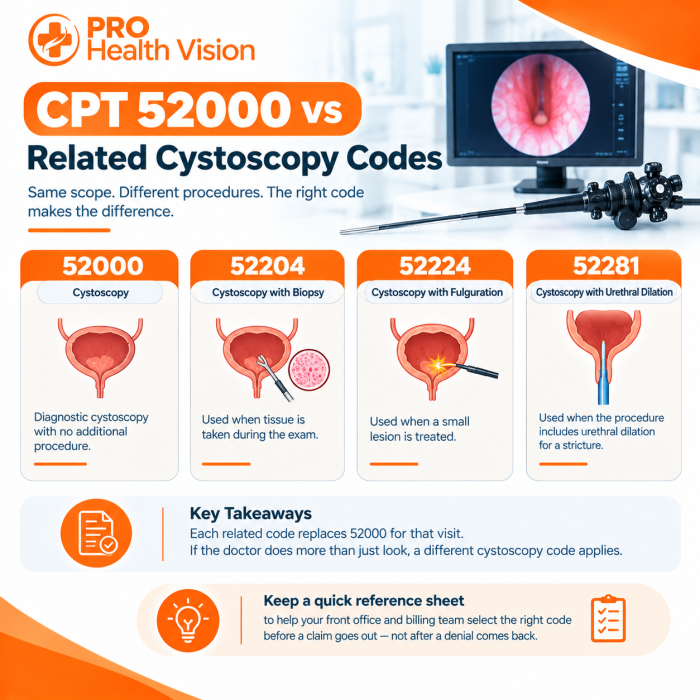
Coders often mix up 52000 with its related codes, since they all start with the same scope. Understanding the difference is part of getting the 52000 cpt code description right in day to day billing.
CPT 52204 covers a cystoscopy with biopsy, used when tissue is taken during the exam. CPT 52224 applies when the doctor treats a small lesion with fulguration. CPT 52281 covers a scope that includes urethral dilation for a stricture.
Each of these related codes replaces 52000 for that visit, since the base cystoscopy procedure code is considered part of the larger service. The general rule holds across nearly all of them: if the doctor does more than just look, a different cystoscopy cpt code applies instead.
Keeping a short reference sheet of these related codes helps front office and billing staff catch the right code before a claim goes out, rather than after a denial comes back.
Why RCM Teams Should Pay Close Attention to CPT 52000 in Urology Billing
Revenue cycle teams see this code often enough that small errors add up fast across a full patient panel. A pattern of incorrect bundling or missing modifiers can trigger a broader payer audit of the whole practice.
Urology practices that track denial reasons by code catch these patterns early. If 52000 keeps getting denied for the same reason, that points to a documentation gap or a workflow issue, not just bad luck.
This is exactly the kind of recurring, high volume code where outside support helps. At Pro Health Vision, our team works as Medical Billing Experts for urology practices, reviewing claims before submission and tracking denial trends so practices get paid accurately and on time.

Common Billing Errors That Lead to Denials
A few mistakes show up again and again with this code.
- Billing 52000 alongside a more specific cystoscopy code for the same visit
- Missing or mismatched diagnosis codes that do not support the reason for the scope
- A chart note that stays vague about why the scope was done
- Using modifier 59 out of habit, instead of checking whether it actually applies
Practices that build a quick internal checklist before submission catch most of these errors before they ever reach the payer.
Conclusion
CPT code 52000 covers a diagnostic cystoscopy, and it only stands alone when nothing else is done during that same visit. Getting the modifiers, documentation, and bundling rules right protects a practice’s revenue every month. Urology teams that stay sharp on this code avoid denials and speed up payment. If your practice wants fewer denials and cleaner claims, contact us at Pro Health Vision to review your urology billing workflow and show you where the gaps are.
FAQs
What does CPT code 52000 mean? It describes a diagnostic cystourethroscopy, a scope exam of the bladder and urethra with no additional procedure performed.
Can CPT 52000 be billed with a biopsy? No. When a biopsy is taken during the same scope, a more specific biopsy cystoscopy code replaces 52000 for that visit.
Is prior authorization needed for cystoscopy? Usually not for a first diagnostic scope, though some payers require it for repeat scopes within a short window.
Why do claims for CPT 52000 get denied? The most common reasons are incorrect bundling with a bigger procedure, missing modifiers, or a diagnosis code that does not support medical necessity.
Does the reimbursement rate change by location? Yes. Office based and hospital outpatient settings often carry different rates for the same code.