The majority of visits for sore throats conclude with a quick strep test, and the accuracy of the strep test CPT code determines whether the visit is reimbursed. A routine claim can become a denial with just one incorrect digit or a missing modifier. The codes, documentation, and 2026 Medicare regulations that billers must be aware of are all broken down in this guide. This was created by Pro Health Vision after examining CPT guidelines and current payer policy. The objective is straightforward: fewer denials, quicker payments, and audit-resistant claims.
What Is CPT Code 87880?
When using direct optical or visual examination, the CPT code for rapid strep test in office for Group A Streptococcus antigen test is 87880. To put it simply, it is the in-office strep test; instead of a lab result that takes days to return, the staff looks at a color line on the strip. The immunoassay approach used in almost all clinics, urgent care centres, and pediatric offices nowadays is covered by this rapid strep CPT code.
You can use it without a full lab license because it is CLIA-waived. The majority of payers, including Medicare, need modifier QW on the claim line to indicate that the test was conducted under that waived status, and the clinic must still have a current CLIA Certificate of Waiver on file. A doctor may diagnose and treat strep throat in a single visit because results typically take five to ten minutes.
Why Choosing the Right Strep Test CPT Code Gets Confusing
There are several codes that seem similar yet describe different test techniques, which causes issues for billers. A CPT code for strep test has to be specific to the technology used, not just the general concept of “strep testing.” Frequently misunderstood topics include:
- Confusing molecular/PCR assays (87651, 87652) with antigen testing (87880).
- Throat culture code (87081) should only be billed after a quick test.
- Medicare claims for waived tests with the modifier QW forgotten
- Reporting a diagnostic code that is not medically necessary
All of these errors result in the same thing: a claim that is rejected or postponed.
CPT 87880 vs. CPT 87430: What’s the Difference?
Practices occasionally continue to see 87430 in outdated templates or systems. In 1998, the American Medical Association clarified that all commercial Group A strep kits should be interpreted by sight using 87880. For this purpose, the enzyme immunoassay format described in 87430 is essentially out of date. The correct CPT code for rapid strep test in office claims is 87880 if a rapid strep kit produces a visual result, like a color shift or a line.
| Code | Test Method | Current Use |
| 87880 | Immunoassay, direct optical (visual) observation | Standard rapid strep test CPT code today |
| 87430 | Enzyme immunoassay | Rarely used now; mostly seen in legacy billing systems |
| 87651 | Nucleic acid, amplified probe technique | Molecular test, higher sensitivity, often CLIA-waived with QW |
CPT Code 87081: When a Throat Culture Confirms the Diagnosis
A presumptive throat culture for the sole purpose of screening for pathogenic organisms is covered by CPT 87081. When a swab is sent to a lab for growth on a culture plate rather than being read at the point of care, this code is applicable.
A throat culture captures some cases that a rapid test missed, but it takes longer than a quick antigen test—typically a day or two. For the same visit, speedy results, billers shouldn’t use 87081. When both are medically appropriate and properly documented, the CPT codes for the strep test billed for a culture and the quick antigen version can be reported together.
Read More: CPT Code 88305 | Description, Billing & Reimbursement
When Is a Confirmatory Culture Required, Not Just Recommended?
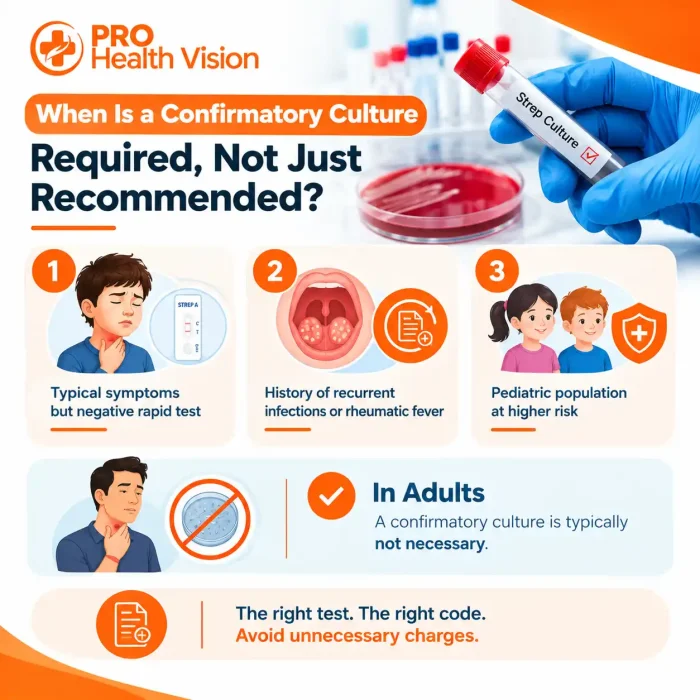
An infection is not always ruled out by a negative fast strep test. Compared to a culture, the rapid antigen approach is less sensitive. In these situations, clinical guidelines typically advise a follow-up culture:
- A child with typical strep throat symptoms but a negative fast test result
- The patient has a history of rheumatic fever or recurrent strep infections.
- Missed strep has a higher risk of complications in the pediatric population served by the clinic.
A confirmatory culture is usually not required in adults with a negative fast test and low clinical suspicion because the risk of complications is decreased. This distinction is crucial for coding because a medical necessity refusal may result from charging for a culture that was not clinically advised.
Medicare Reimbursement for CPT 87880 in 2026
The Medicare Administrative Contractor region and geographic location will determine the precise cost, but the average Medicare national reimbursement for CPT 87880 in 2026 is expected to be between $18 and $22. Instead of using a fixed amount, billers should use the CMS Physician Fee Schedule Look-Up Tool to confirm the rate for their location. This rapid strep CPT code is subject to the following Medicare-specific regulations:
- For CLIA-waived status, Modifier QW must show up on the claim line.
- When necessary, the CLIA certificate number should be included on the claim and kept on file.
- There is no single national Medicaid figure because Medicaid coverage and rates differ by state.
ICD-10 Codes Commonly Paired with CPT 87880
Every laboratory claim must be supported by medical necessity. Choose primary diagnosis codes that accurately correspond to provider documentation.
- J02.0: Strep throat, or streptococcal pharyngitis
- J02.9: Acute, unidentified pharyngitis
- J03.00: Unspecified acute streptococcal tonsillitis
- R07.0: Sore throat (throat pain)
- R50.9: Nonspecific fever
When infection is confirmed by diagnostic results, always bill J02.0. If rapid testing yields negative results, use symptom codes such as R07.0.
What Documentation Is Needed to Bill CPT 87880?
During payer reviews, reimbursement claims are defended by clear chart entries. Providers need to record:
- Sore throat, fever, or swollen lymph nodes are the main complaints.
- Physical examination results showing redness or tonsillar exudate.
- Rapid antigen testing order entry.
- Records of test results showing favorable or unfavorable results.
- Names of specific kit manufacturers and dates of lot expiration.
Modifier 25 should be added to the E/M code when billing an evaluation and management (E/M) service with a test. This demonstrates that the diagnostic swab procedure and the office visit were distinct.

Common Billing Errors With CPT 87880
The majority of denials associated with this code are caused by a few recurring errors:
- Billing 87880 when the outcome was read by an automated analyzer rather than a human eye
- Ignoring the QW modifier on a Medicare claim
- Combining the code with a diagnosis that refutes a visit related to strep
- Double billing for a culture and a quick test without explaining the need for each
Conclusion
Even though strep testing is common, busy practices are still troubled by the associated billing. Accurately determining the strep test CPT code, along with the corresponding diagnosis and supporting documentation, ensures that claims proceed and payments are made on time. Every day, Pro Health Vision works with clinics to close precisely these kinds of coding gaps. Contact Pro Health Vision to have your procedure reviewed and made more stringent if your practice wishes to reduce the number of rapid strep claim denials.
FAQs
1: What is the rapid strep test CPT code?
For visually read, in-office rapid antigen tests for Group A strep, the standard code is 87880.
2: Is a throat culture the same as CPT 87880?
The rapid antigen test is covered by No. 87880. A throat culture takes longer to process and is billed under 87081.
3: Does CPT 87880 require the modifier QW?
Most payers, including Medicare, require modifier QW to show the test was conducted under CLIA-waived status.
4: Which ICD-10 code corresponds to a strep test result that is positive?
The standard code for a confirmed positive result is J02.0, streptococcal pharyngitis.
5: Is it possible to bill 87880 and 87081 on the same visit?
Yes, provided that the record clearly explains why a culture is medically required to confirm a negative rapid test.